New York State Unemployment Insurance Help
6 years ago

One of the most powerful things a leader can do to build a strong organizational culture is to just be himself. For us lucky Double-Take employees, we have a great example at the top of our organization.
Four or five times a year, Double-Take Software CEO Dean Goodermote makes a drastic wardrobe change to entertain his clients. His necktie is replaced with love beads. His suit is replaced with a tight, sleeveless T-shirt, capri pants and bright orange-and-blue sneakers – an homage to the company colors.
Cluster-Funk at Tech Ed from DBTK on Vimeo.
We all do it. It's a curse of being human and unfortunately no matter how hard we try be perfect, hardworking, efficient workerbees who come in to do the job and then go home...
Our emotions get the best of us. At some point or another, life takes it toll and we react. We blow steam in the office, go off on a rant during lunch, mutter under our breath. It happens. We're human. I get that.
But are our reactions appropriate? Justified? ...Expected? Even better: are your reactions INTENTIONAL? Do they further your position?
Consider the last time your emotions got away from you and you reacted in a way that didn't serve you or the organization best:
Next time you have to react, press PAUSE. If not PAUSE, hit the 5-SECOND DELAY. Give yourself some time to let the rational thinking section of your brain dissect how you feel vs. how you're going to react.
This type of emotional control takes practice. A lot of it. Start by asking these questions in real time as you feel your emotions getting the better of you, before you react. With practice and a few deep breaths, you may be able to hit the pause button and become more intentional with the emotions you use in the workplace -- they'll push your agenda much further than flying off the handle ever will.

I bet you would all agree with me that loud, rude, and/or negative people in the workplace are not the reason you show up everyday. Most of you would probably agree the rude and mouthy people can be really damaging to your outlook and mood. For instance, how do you feel after hearing someone fly off the handle, yell, and curse over something as small as a rescheduled meeting or unexpected phone call from a sales person?
For the grand majority of us, the instinct to take flight (aka: lay low) takes over. And even if the outburst wasn't aimed at you, guess what happens: your focus, engagement, productivity and creativity are out the window.
This article highlights some research that confirms our intuition about these folks in the workplace. The study shows that rude behavior has an effect on productivity and creativity. And I guess if we're noticing a decline in productivity, creativity, engagement, innovation, etc... we could safely assume it's having an impact on the bottom line, as well.
“We found that even when the rude behavior is pretty mild, it impairs a person’s cognitive functioning and has spillover effects in how they treat their co-workers,” said Amir Erez, a University of Florida management professor.
The unusual study, by Erez and Christine Porath, a management professor at the University of Southern California, appears in the October issue of the Academy of Management Journal.
This well-crafted research shows that when organizations allow rude employees to run roughshod over others, it not only creates uncivilized workplaces, it is just plain bad business.
Take note, and don't let your temper tantrum run roughshod over your employees.
OK, I'm going to show a little of my nerdiness here, but do you remember 2 years ago when the International Astronomical Union striped Pluto of its "planet" status? Most of you probably heard about it, many of you probably didn't really care... but I urge you to consider this:
If change can happen to something as certain as a PLANET, it can certainly happen to us. And it does. Everyday.
Pluto's reclassification changed the rules of the game, and organizational change can be like that too. There you were confident and comfortable with your boss, and now you must readjust and reorient to a new one with a different style, focus, and rules. Like it. Don't like it. Regardless, get on board!
"Change is good. Everybody is doing it... Get on board!" -- Will Anderson, Channel Marketing Manager, Double-Take SoftwareThere there 3 things to know when change is afoot. First, when the rules change, it's uncomfortable... but then you get used to it. Second, your future depends on letting go of the unease and moving forward with the times. Third, this is your growth spurt!
By: Emily Stevens
When running a kickoff meeting, it's important to get down to business immediately, right? And when you complete that project, isn't it great to take the team out to a nice steakhouse, and maybe even (in better economic times) buy them a round of drinks?
Or is it?
In some cultures, jumping right into a meeting without taking the time to know something about one another is considered rude and counterproductive. And what you think is a reward (steak and a martini) might create an awkward moment for a team member who is vegetarian or who doesn't drink, for religious or other reasons. Clearly, it's important to be aware of the friction points which can arise in a diverse workplace. You may be traveling the globe, or may simply have people from various cultures and backgrounds to work with here at home. Either way, here are some key distinctions to consider:
Tradition versus change: Here in the U.S. we tend to assume that we should "embrace change". However, in other cultures there may be less willingness to assume that all change is positive. Be willing to spend time justifying change, and know that customers' or employees' objections and fears will help you better identify risk areas and mitigate them. Your change initiative can benefit from listening to those who are concerned.
Relationships: Do you get to know people before working with them, or is working together the means to know one another? Different cultures have different views. A good rule of thumb is to always take a few minutes at the beginning of a meeting to introduce people and orient them to each other. Even an established team can have fun with a few icebreakers which help them learn new things about one another.
Time: Is a culture punctual or casual about time? We are mostly a punctual society. If you have an employee who is less than punctual, the issue may be more cultural than attitudinal, so be friendly and fair, but firm about the need to be at work on time. That said, many workplaces today have less emphasis on being punctual, and more emphasis on simply being available, such as by Blackberry. Define your expectations and communicate them clearly.
Formality: Cultures are very different in how they approach formality in a relationship. To be safe, always start formally and become more casual as you build a relationship. Be careful about names, how quickly you go from a formal last-name-only greeting to first names. Also, be sensitive to physical distance, eye contact, and whether a friendly touch on the arm or pat on the back would be welcome or not. And, in any culture, never pat a pregnant woman's stomach. Just don't. There are other ways to communicate your support, congratulations and good wishes.
Communications: You can communicate very directly, meaning you are candid even to the point of not considering your listener's feelings. The advantage of direct communications is that they are efficient and leave no room for doubt. Indirect communications may be more focused on allowing the listener to save face but may be less clearly understood. The best practice is to structure your message carefully and deliver negative messages privately.
Rewards and Recognition: Give a lot of thought to the rewards you bring into the workplace. There’s nothing wrong with checking with people on their preferred rewards—and what they ask for may actually be easier and cheaper than what you were planning. Food, after-hours celebrations, and even public recognition may be less rewarding than you think.
One final thought: how are you setting up meetings, if you have participants across the globe? Consider the effect on those in other time zones, and balance how frequently you ask them to accommodate early or late calls. And, it’s always nice to ask about holidays when setting up a meeting schedule. You don’t have to know every holiday in every country or religion, but you can be respectful of holidays as an issue.
Diversity in your workplace can be a great source of innovation and learning for your organization. Respect is the key word: it’s what makes the difference between conflict and synergy.
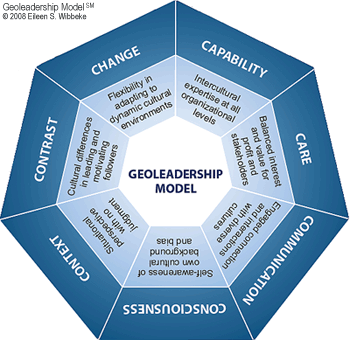
Did you know that that 70% of global business ventures worldwide fail due to mismanagement of cultural differences? While our company quickly grows and continues to expand into various countries and cultures, its vital that global leadership is developed throughout the organization.
Eileen Wibbeke, creator of the GeoLeadership Model, states that in addition to extraordinary business leadership skills, a leader now needs cultural intelligence.
Wibbeke explains, “Learning how to interact in other cultures takes effort beyond just learning another culture’s language. For the American business leader operating in another culture, interaction requires a deeper cultural understanding about how things are done." Read more.